

FOR SMALL BUSINESS
AI for small business owners, starting from zero.
You run the place, answer the phone and do the books after closing. You don't need a course to get help from AI. You need a few good things to type. Here are five, for jobs you already do every week.
Before you start
- Open any AI chat app. ChatGPT, Claude or Gemini all work, and the free versions are fine for this.
- Copy a prompt below and swap everything in [square brackets] for your own details.
- Read the answer, then talk back. "Shorter." "Less formal." "That's not true, we close at 6." The second answer is usually the one you keep.
Everything AI writes is a first draft. You read it before a customer, applicant or landlord ever sees it.
1. Answer a review, good or bad
A one-star review stings, and the reply you write at 11 pm is rarely the one you want public. Let AI write the calm version.
I run a [type of business] in [town]. A customer left this review: [paste the review]. Write a public reply from me, the owner. Thank them by first name, say plainly what we got wrong without making excuses, mention one specific thing we are doing about it, and invite them to reach me at [business email or phone]. Keep it under 80 words and sound like a real person, not a company. Skip phrases like "valued customer" and "any inconvenience." Give me two versions: one short, one a bit warmer.
For a good review, swap the middle part for: "Thank them, mention the exact thing they liked, and keep it to two sentences."
2. Write a job post people actually finish reading
Most job posts are a list of demands. A clear, honest one gets fewer applicants who quit in week two.
Help me write a job post for a [role] at my [type of business] in [town]. What the job really involves day to day: [list the tasks]. Pay: [range]. Hours: [days and times]. Must-haves: [only the true ones]. Write it in plain words: two sentences about us, what a normal shift looks like, what we need, what we offer, and how to apply. Under 250 words. Then point out any line that might put off good applicants or sound like it shuts some people out, and suggest a better wording.
Hiring rules differ by state and country. Check anything about pay, age or schedules against your local rules before you post.
3. Follow up on a quote without sounding pushy
You sent a price a week ago and heard nothing. A short, friendly nudge wins back more jobs than people expect.
I sent a quote to a possible customer [number] days ago and haven't heard back. The job: [one line, like "repainting a two-bedroom apartment"]. The quote was [amount] and could start [date]. Write a short follow-up email. Friendly, not pushy. Remind them what they'd get, gently answer the worry they most likely have about [price, timing, mess, or something else], and end with one easy question they can answer in a single line. Under 100 words, plus a subject line. Use only their first name, [first name].
If it sounds too eager, reply: "Calmer. Like I'm busy and happy either way."
4. Turn a messy week into a plan
When everything feels urgent, the jobs that bring in money get pushed to Friday night. This one sorts it for you.
Here is everything on my plate this week, in no order: [paste your list, typos and all]. Outside of serving customers I have about [number] hours for this. Sort it into three groups: must do this week, can wait, and can hand off or drop. Put anything that brings in money or protects money first, like invoices, quotes and bills. Then give me a Monday to Friday plan with no more than three main tasks a day. Flag anything that looks like it has a deadline I haven't mentioned.
Keep the plan in the chat. On Wednesday, paste in what you actually got done and ask it to redo Thursday and Friday.
5. Read a contract clause in plain English
Leases, supplier terms and card processing agreements are written so nobody reads them. AI can't give you legal advice, but it can tell you what a clause says and what to ask.
I own a small business and I'm not a lawyer. Explain this clause from my [lease, supplier agreement, service contract] in plain English: [paste only the clause, with names and account numbers taken out]. Tell me: what it makes me do, what it lets the other side do, what happens if I want to leave early or something goes wrong, and anything that seems unusual for this kind of agreement. Then give me three questions to ask the other side, or a lawyer, before I sign.
Use this to understand, not to decide. If a lot of money, a long lease or a personal guarantee is involved, pay a lawyer to read it.
Ready for more? See 12 more ChatGPT prompts for small business: customer emails, social posts, price lists and quotes.
What never to paste into AI
What you type goes to the company that runs the app. Use the same care you'd use with a new temp worker on their first day.
- Passwords and logins, including for your bank, payroll or point of sale.
- Card, bank and tax numbers, yours or anyone else's.
- Customer details beyond a first name: no addresses, phone numbers, order histories or contact lists.
- Employee records: pay, health, reviews or anything from a personnel file.
- Whole contracts with names in them. Paste the one clause you need, with names and numbers removed.
- Anything you signed an agreement to keep private.
Also check the app's settings. Most let you choose whether your chats are used to improve the app.
New to AI yourself?
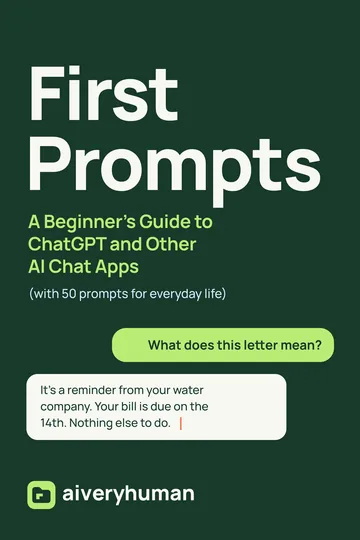
First Prompts is a 68-page plain-English beginner’s guide to AI chat apps, plus 50 prompts for everyday life. It’s a beginner’s guide, not a business book: it has a short section on work and getting organized, like planning your day and tidying a rough email.
Get First Prompts for $9.99Instant PDF download. All sales final. Look inside first.
Questions owners ask
Do I need to pay for an AI app?
No. The free versions of ChatGPT, Claude and Gemini handle all five prompts on this page. Paid plans mostly give you more use per day.
Is it safe to paste customer details into AI?
Keep it to a first name. What you type goes to the company that runs the app, so leave out addresses, phone numbers, card details and anything from an employee file. See the list above, or our guide Is it safe to use AI?
Can AI give me legal or tax advice?
No. It can explain what a clause or a letter says in plain English and help you prepare questions. For decisions with real money or risk, ask a lawyer or accountant.
How long does this take to learn?
About ten minutes for your first useful result. Copy one prompt, fill in the blanks, and read the answer. Most owners start with the review reply or the weekly plan.
Now on Kindle: AI for Your Small Business. 50 prompts for customer replies, quotes, reviews and hiring, written for owners who have never used AI. $6.99 on Amazon.
One plain-English AI tip a week.
A short, free email with one thing to try in your AI app, including tips for running a small business. Unsubscribe any time.