

Is This a Scam?
For the moment a text, call or email makes your stomach drop and you’re not sure. Here are the four signs most scams share, a made-up example, and what to do next. Then, if you want the full guide, you can get the $9.99 PDF or the Kindle edition.
Download the free one-page sheet: how to spot a scam fast. No email needed. Print it for the fridge or send it to someone you look out for.
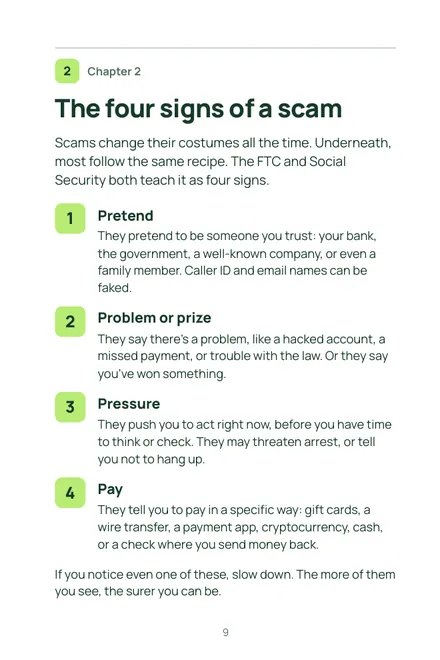
The four signs of a scam
Scams change their story. The signs stay surprisingly similar. If you see more than one, pause.
- Pretend. They claim to be your bank, the government, a company you know, or a family member.
- Problem or prize. Your account is locked, you owe a fee, a package is on hold, or you won something you didn’t enter.
- Pressure. Act right now. Don’t hang up. Don’t tell anyone.
- Pay or share. Gift cards, a wire, a payment app, crypto, cash, a check they want you to send money back from, or a code that was just texted to your phone.
A made-up example
Imagine a text from a number you don’t know: “Example Parcel: Your package is on hold, incomplete address. Pay the $1.25 redelivery fee within 12 hours or it will be returned,” plus a link. That message is invented for this page, but the pattern is common.
- A number you never signed up for.
- A tiny fee plus a deadline. The real target is often your card number.
- A link to “fix” it. The real postal service does not text surprise payment links.
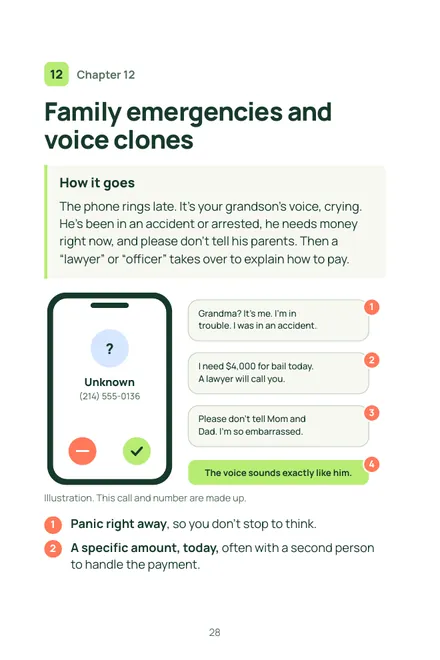
The same four signs show up in calls too: a “grandchild in trouble,” a “fraud department” that must stay on the line, or a pop-up that tells you to call a number. Hang up. A real company or relative can be reached on a number you already have.
What to do next
- Don’t tap the link, call the number in the message, or read out a code.
- Look up the real number yourself, like the one on the back of your card, and contact the company that way.
- Forward scam texts to 7726 (SPAM). Report scams at ReportFraud.ftc.gov. If you are 60 or older, the Elder Fraud Hotline is 833-372-8311.
- If you’re in danger, call 911. If you already clicked, paid or shared something, contact your bank or card company right away.
For the privacy side of AI chat apps, see whether ChatGPT and other AI chat apps are safe to use. For a slower walkthrough written for older adults, see ChatGPT for seniors.
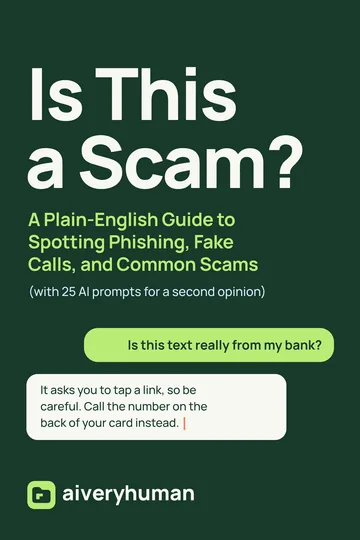
$9.99
- 70 pages, big print, 6 by 9 inches
- A plain-English guide plus 25 prompts
- Checklists, cards and a “My trusted numbers” page to print
- Written for readers in the United States
Instant PDF download. All sales final. Billed by DataChime LLC. Sales and support policy
Prefer Kindle? Safe in the Age of AI is a calm, plain-English scam-safety ebook on Amazon, $5.99.
Who it’s for
- You get texts, calls and emails that look real and you’re never quite sure.
- You look out for a parent or grandparent and want one clear thing to share with them.
- Something already happened, and you want to know what to do next and where to report it.
No tech skills needed, and you don’t need to use AI to get value from it. Parts 1 to 5 and the printables stand on their own. The prompts are an optional second opinion.
What you’ll be able to do
- Spot the four signs nearly every scam shares, whatever the story.
- Check an email, a text, a web address or a voicemail before you act on it.
- Recognize 12 common scams, from fake bank alerts and toll texts to voice clones and romance scams, plus the payment methods scammers ask for.
- Know exactly what to do in the first hour if you clicked, paid or shared something.
- Ask an AI app for a second opinion safely, without pasting codes or account numbers.
Look inside
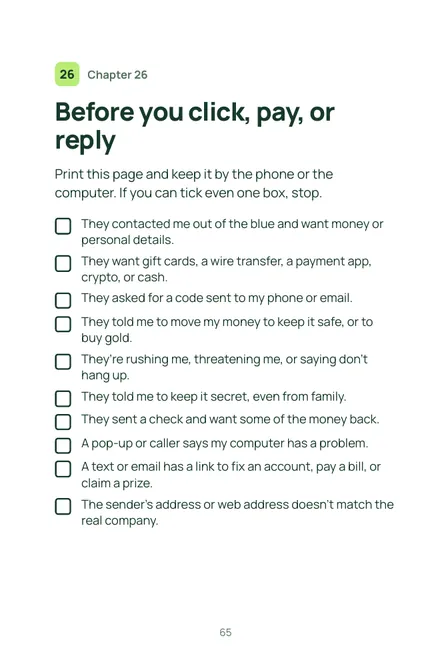
Real pages from the guide, shown smaller than they print.
What’s inside
- Part 1: How scams workStart here. The four signs of a scam.
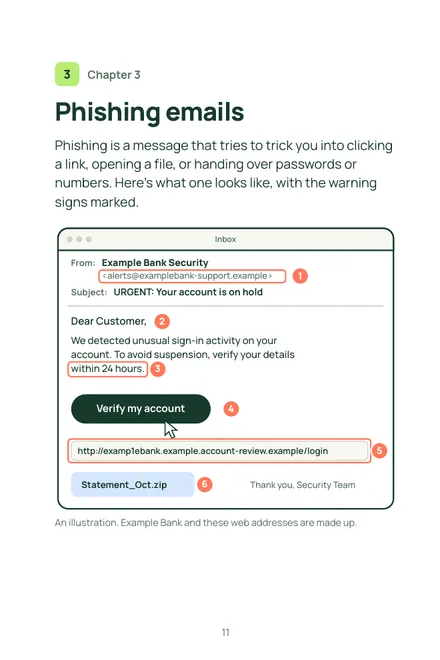
- Part 2: How to spot phishingPhishing emails. Reading a web address. Scam texts. Phone calls and voicemail.
- Part 3: Common scams, one by oneBank and fraud alerts, package and toll texts, government imposters, tech support, fake invoices, family emergencies and voice clones, romance, prizes, jobs, QR codes, buying and selling online, deepfakes, and how scammers ask to be paid.
- Part 4: Everyday defensesHabits that protect you. Lock down your accounts.
- Part 5: If it already happenedAlready clicked, paid, or shared? Where to report and get help.
- Part 6: Your AI helper toolkitUsing AI as a second opinion, and 25 prompts for texts, emails, calls, letters, websites and money requests.
- Part 7: PrintablesBefore you click, pay, or reply. Quick-reference cards. My trusted numbers.
Free sample: how to spot a scam fast
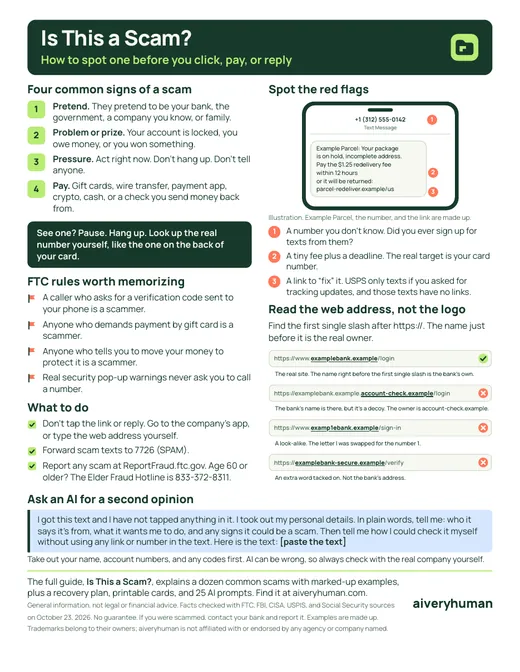
A one-page sheet with the four signs and what to do instead. Print it for the fridge or send it to someone you look out for. No email needed.
Download the free sheet (PDF)한국어 버전 (Korean version)
Is This a Scam? is a $9.99 PDF: a plain-English guide plus 25 prompts, 70 pages.
Get Is This a Scam? for $9.99Instant PDF download. All sales final. Prefer Kindle? Safe in the Age of AI on Amazon.
Questions people ask
Do I need to use AI to get something from it?
No. Most of the guide is about spotting scams yourself: the four signs, how to read a web address, and what to do if it already happened. The 25 prompts in Part 6 are an extra, and they work in the free versions of ChatGPT, Claude and Gemini.
How current is it?
Facts, phone numbers and web addresses were checked against official sources such as the FTC and FBI on October 23, 2026. Scams change quickly, so the guide shows you how to confirm details on official websites too.
Can I print it?
Yes. You may print the checklist, cards and trusted-numbers pages for your own household. The whole PDF prints on regular home printer paper.
Can it help if I’ve already been scammed?
Part 5 walks through what to do right away and where to report it. It’s not a recovery service, and no one can promise money back. If you think you’ve been scammed, contact your bank or card company right away.
Can I get help?
All sales are final since it’s an instant download. If you have a question about the guide, email hello@aiveryhuman.com. We can’t tell you whether a specific message is a scam.
A note before you buy. Is This a Scam? is general educational information to help you recognize common scams. It isn’t legal, financial, tax or security advice, and it can’t cover every situation. Following it can lower your risk, but nothing can guarantee you won’t be targeted or lose money.
If you’re in danger, call 911. Example emails, texts, calls and web pages in the guide are made up. aiveryhuman isn’t affiliated with the FTC, FBI, any other government agency, AARP, or any company named in the guide.